

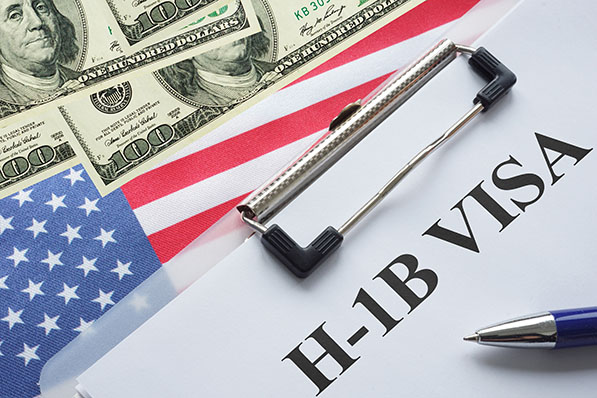
On August 24, 2026, the Department of Homeland Security (DHS) published a proposed rule that would establish a $103,265 fee for all H-1B visa petitions subject to the H-1B visa cap, including those eligible for the advanced degree exemption.
The proposed fee would generate revenue to recover some of the government’s cost of administering the immigration system, including “adjudication of immigration benefits, fraud detection and national security vetting, systems modernization, records and fee collection operations, immigration court operations, consular visa processing, labor standards enforcement, and interagency coordination,” according to the DHS press release.
Under this proposed rule, the additional fee wouldn’t apply to H-1B petitions that are not subject to the cap, such as petitions filed by certain nonprofit research organizations, governmental research organizations and higher education institutions. The number of cap-subject petitions allowed annually is 65,000, with an additional 20,000 for those who have earned a master’s degree or higher.
If this sounds familiar, it’s because the federal government already attempted to include a $100,000 fee with each visa petition after President Trump issued a proclamation to that effect on September 19, 2025. The proclamation stated that the measure was intended to address abuse of the H-1B visa program.
Shortly after the proclamation, several lawsuits were filed challenging the fee. Most recently, on June 8, 2026, a federal district court in Massachusetts vacated the fee, concluding that it was a tax that only Congress can impose. The Massachusetts court’s ruling conflicts with another federal court in the District of Columbia that upheld the fee in December 2025, finding that the president had broad authority under the Immigration and Nationality Act to regulate entry into the United States and that the proclamation falls within that authority. These cases are still on appeal in their respective circuit courts.
While the proclamation-related appeals process unfolds, the DHS’ newly proposed fee seeks to add a similar fee to H-1B petitions but is doing so through the formal rulemaking process. This rule has been published in the federal register, and interested parties can comment on the proposal through September 24, 2026. The DHS will review comments before issuing a final rule.
Employers using the H-1B visa program should review the proposed rule and work with legal counsel to determine how it may impact their organization, including budgeting for future H-1B petitions if the fee is finalized for the 2028 cap season as well as reviewing which positions are subject to the H-1B visa cap and which are cap-exempt.
James W. Ward, J.D., Employment Law Subject Matter Expert/Legal Writer and Editor, CalChamber
CalChamber members can read more about the H-1b Visa in the HR Library. Not a member? Learn how to power your business with a CalChamber membership.
