

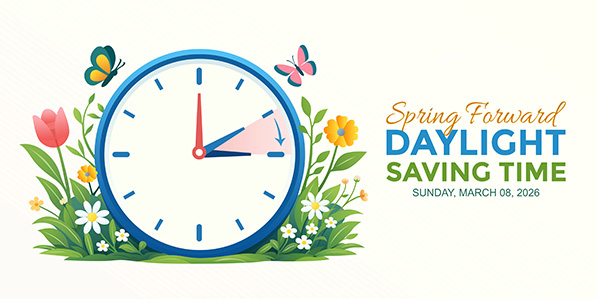
On Sunday, March 8, 2026, daylight saving time (DST) begins! At 2 a.m., our clocks spring forward, meaning we lose an hour, which may cause some complications for employers’ timekeeping practices. But employers should also keep in mind how the time change can affect employees’ health and well-being.
Employers need to be prepared when the time change affects an employee’s shift, such as a graveyard shift, because employees only need to be paid for the actual time worked. Since DST starts on Sunday at 2 a.m. — meaning 2 a.m. instantly becomes 3 a.m. — overnight-working employees may only work and need to be paid for a seven-hour shift that night. Employers are encouraged to review their timekeeping practices so all employees are paid for all hours worked.
Beyond paying employees accurately, the annual time change can also lead to health and safety issues. When DST shifts the clock forward, people often struggle to adjust, which can lead to sleep deprivation. Sleep loss can strain the cardiovascular system, leading to a 24% increase in heart attack rates the Monday after DST starts, according to a study of hospital admissions. Plus, due to an “earlier” wake up time on Monday, employers and their employees might be sleepier or even grumpier. This is usually the reason that studies show a significant increase in traffic accidents and workplace injuries the week following the beginning of DST.
Employers may want to reevaluate their workplace health and safety programs for next week. Some common safety tips for the week following DST are:
- Adjust schedules, if possible, on the Monday following the time change;
- Postpone high-risk tasks until later in the week when employees have adapted to the time change; and
- Reinforce safety protocols.
Finally, don’t forget to move your clocks forward on March 8!
Katie Culliton, Senior Editor, CalChamber
CalChamber members can read more about Timekeeping and Recording Guidelines in the HR Library. Not a member? See what CalChamber can do for you.
